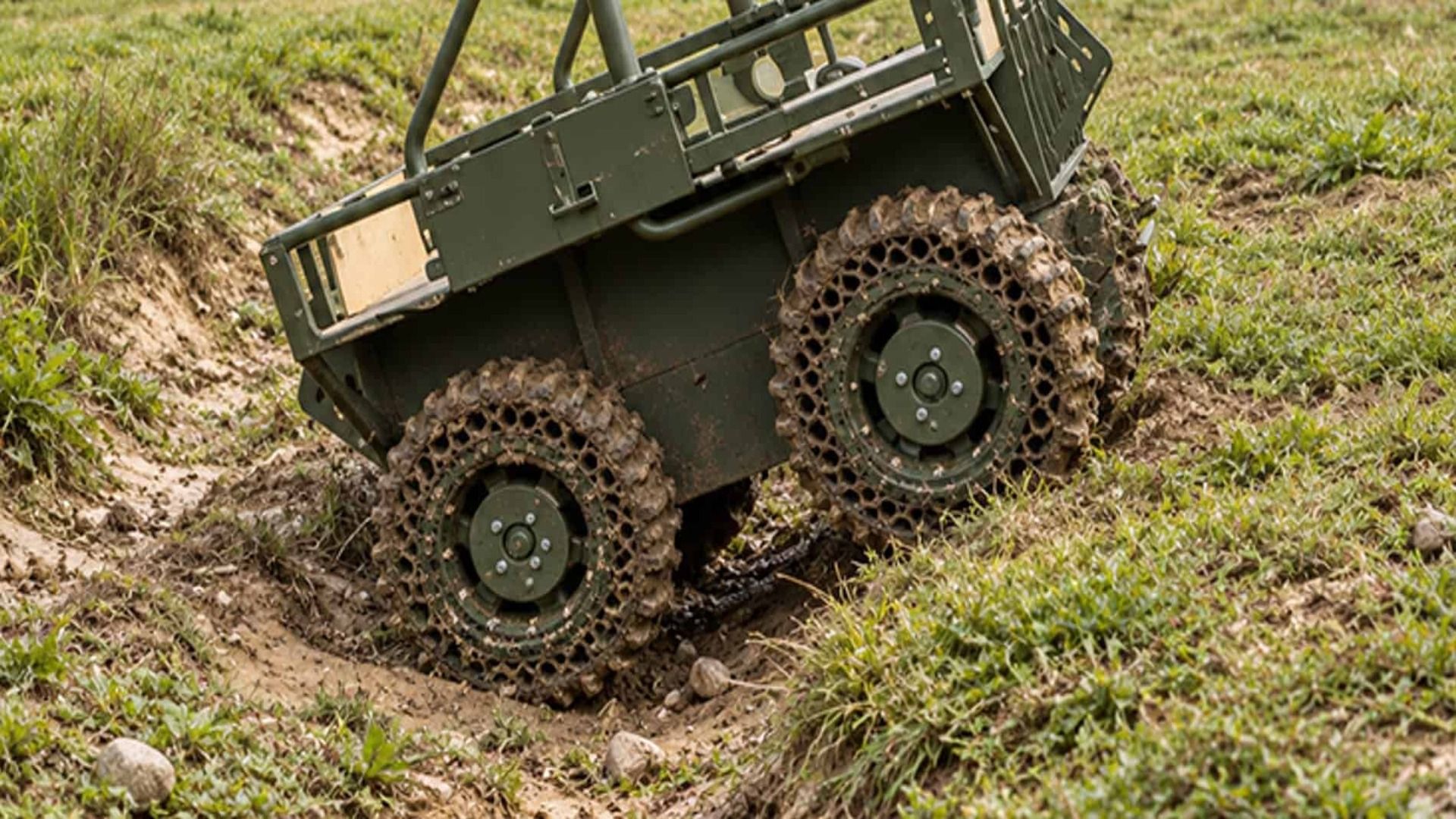
3D-printed airless wheels could be a game changer for Ukraine's ground robotic vehicles — ultralight no-deflation tyres improve resistance to punctures and explosions
Ukrainian developers complete combat trials of airless wheels for ground robots New 3D-printed wheels eliminate inflation requirements for battlefield robotic vehicles Ukrainian wheel sets weigh between 32 and 56 kg Ukrainian engineers have developed inflation-free wheels for unmanned ground vehicle
<![CDATA[ <article> <ul><li><strong>Ukrainian developers complete combat trials of airless wheels for ground robots</strong></li><li><strong>New 3D-printed wheels eliminate inflation requirements for battlefield robotic vehicles</strong></li><li><strong>Ukrainian wheel sets weigh between 32 and 56 kg</strong></li></ul><p>Ukrainian engineers have developed inflation-free wheels for unmanned ground vehicles, aiming to keep robotic platforms moving despite damage encountered during frontline operations.</p><p>The project brings together Print&Live UA, iSCALE 3D, and participating specialists, who have completed field evaluations and combat trials of the new wheel designs.</p><p>The airless wheel is produced using large-scale 3D printing technology, and it has a rounded tread, a closed profile, and a two-piece disc.</p><h2 id="lightweight-construction-addresses-battlefield-mobility-risks">Lightweight construction addresses battlefield mobility risks</h2><p>Its design increases the cross-country ability, energy efficiency, and maintainability of robotic equipment on the front line.</p><p>Conventional tyres can become unusable after encountering fragments, blast effects, rubble, barbed wire, or frozen terrain, immobilizing remotely operated vehicles.</p><p>Such failures can leave equipment exposed, while recovery operations may require personnel to approach locations where hostile fire remains a concern.</p><p>The Ukrainian design eliminates dependence on internal air pressure, allowing the wheel to retain its supporting function without inflation or routine pressure maintenance.</p><p>Its internal structure uses a digitally adaptable lattice made from durable elastomers and composite polymers.</p><p>Unlike designs with exposed cellular structures or flat running surfaces, the wheels feature enclosed construction and curved tread geometry.</p><p>The tyre is designed to limit the amount of dirt, stones and ice accumulating around the wheels during operation over difficult ground.</p><p>Their relatively low mass and rounded profile are also intended to limit ground contact and rolling resistance, potentially reducing the energy required for movement.</p><p>Print&Live estimates that the design could extend the operating distance of ground robotic vehicles by as much as 30% compared with foreign alternatives.</p><p>The complete wheel set weighs between 32 and 56 kg, compared with 88 to 144 kg for the cited foreign airless alternatives.</p><p>However, conventional pneumatic sets weigh about 30 to 72 kg, meaning the Ukrainian design does not necessarily outperform every traditional tyre on weight alone.</p><p>Reducing unsprung and rotating mass could nevertheless ease mechanical demands on the gearboxes and electric drive systems used by robotic platforms.</p><h2 id="digital-customization-and-field-repairs">Digital customization and field repairs</h2><p>The manufacturing approach allows engineers to adjust wheel stiffness, shock absorption and geometry digitally according to a robot's weight and operating requirements.</p><p>These adjustments can change product characteristics without requiring manufacturers to reorganize their production lines, potentially simplifying the development of specialized variants.</p><p>Field servicing is another consideration, with the patented two-piece rim allowing damaged tyres to be installed or replaced without conventional tyre-changing machinery.</p><p>The developers say this arrangement removes the need for specialized presses, potentially making repairs easier where workshop facilities and equipment are unavailable.</p><p>A complete set reportedly costs approximately €680, although the available information does not specify the precise configuration or replacement costs included in that price.</p><p>The project has passed its research and development phase, and production is already taking place in limited quantities for subsequent delivery to combat units.</p><p>Independent operational evidence will be needed to establish how the wheels perform under sustained use, repeated impacts and varying battlefield conditions.</p><p>Via <a href="https://militarnyi.com/uk/news/v-ukrayini-print-live-ta-iscale-3d-stvoryly-legki-bezpovitryani-kolesa-dlya-nrk/" target="_blank" rel="nofollow">Militarnyi</a> (originally in Ukrainian)</p><figure class="van-image-figure inline-layout" data-bordeaux-image-check ><div class='image-full-width-wrapper'><div class='image-widthsetter' style="max-width:676px;"><p class="vanilla-image-block" style="padding-top:31.51%;"><img id="diM9tpwF2Lz85R8q85CT78" name="tr-g_news" alt="Google logo on a black background next to text reading 'Click to follow TechRadar'" src="https://cdn.mos.cms.futurecdn.net/diM9tpwF2Lz85R8q85CT78-1920-80.jpg" mos="" align="middle" fullscreen="" width="676" height="213" attribution="" endorsement="" class="inline"></p></div></div></figure> </article> ]]>
Read the full article on TechRadar
Read Full Article →