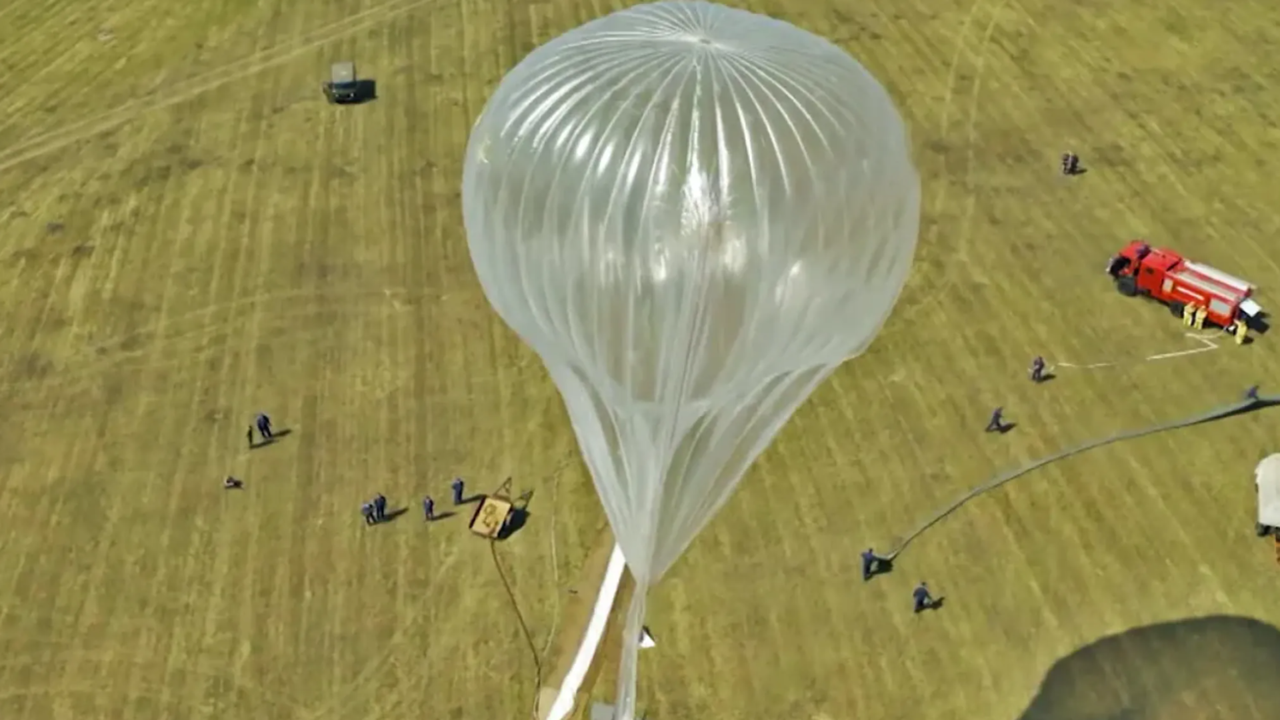
A stratospheric balloon could become a high-altitude drone carrier, capable of loitering for weeks and launching solar-powered UAVs
Military balloons now launch reusable drones directly from the stratosphere Solar-powered Apollo-R remains airborne for weeks after balloon deployment at altitude Thunderhead balloon carries multiple drones during a single high-altitude deployment mission High-altitude balloons are moving beyond sur
<![CDATA[ <article> <ul><li><strong>Military balloons now launch reusable drones directly from the stratosphere</strong></li><li><strong>Solar-powered Apollo-R remains airborne for weeks after balloon deployment at altitude</strong></li><li><strong>Thunderhead balloon carries multiple drones during a single high-altitude deployment mission</strong></li></ul><p>High-altitude balloons are moving beyond surveillance roles as military developers explore using them as airborne launch platforms for long-endurance unmanned drones.</p><p>According to Aerostar, its Lightning balloon, paired with the solar-powered Apollo-R drone from Icarus, has now demonstrated a workable path toward stratospheric drone carriers.</p><p>Recent testing reportedly showed the balloon successfully releasing a single high-endurance uncrewed aircraft while cruising high in the open stratosphere.</p><h2 id="lightning-and-thunderhead-offer-different-endurance-profiles">Lightning and Thunderhead offer different endurance profiles</h2><p>The Lightning platform operates for up to three days at altitudes between 50,000 and 78,000 feet, carrying payloads of up to 45 pounds.</p><p>Aerostar's larger Thunderhead balloon covers a similar altitude band, between 55,000 and 75,000 feet, but stays aloft for 60 days or more.</p><p>The company claims that its Thunderhead can carry payloads weighing up to 200 pounds, allowing it to launch several Apollo-R <a href="https://www.techradar.com/cameras/drones/best-drone">drones</a> per mission.</p><p>"Our larger Aerostar Thunderhead platform can serve as a mothership, carrying multiple Apollo-R's," said Russ Van Der Werff, Aerostar's Vice President of Stratospheric Solutions.</p><p>The Apollo-R itself flies under its own power after separation, reaching altitudes near 60,000 feet and remaining airborne for weeks.</p><p>Unlike a one-way munition, it is designed for recovery, landing at a designated point so the airframe can be reflown on later missions.</p><p>Aerostar's balloons also carry mesh-networking radios that offer line-of-sight data links beyond 100 miles, with throughput up to 40 Mbps.</p><h2 id="military-interest-extends-beyond-a-single-program">Military interest extends beyond a single program</h2><p>The U.S. Army has outlined plans for a persistent, all-domain sensor architecture built partly around <a href="https://www.techradar.com/pro/like-googles-project-loon-but-for-missiles-ukraine-is-weaponizing-stratospheric-balloons-to-boost-strike-range">high-altitude balloons</a> across the Indo-Pacific theater.</p><p>Andrew Evans of the Army's G-2 office described the goal as demonstrating autonomous swarming that sustains a cost-effective stratospheric presence.</p><p>Apollo-R has already flown from a competing Urban Sky balloon during Exercise Valiant Shield 2026, showing multiple companies now pursue similar concepts.</p><p>Balloon-launched drones are gaining traction in Ukraine while China has invested heavily in comparable swarm capabilities of its own.</p><p>Similarly, Russia is equipping its <a href="https://www.techradar.com/pro/russia-is-launching-a-stratospheric-balloon-relay-network-to-counter-starlink-restrictions-but-it-has-one-major-flaw-the-wind">stratospheric balloons with relay networks</a> to counter Starlink restrictions.</p><p>Van Der Werff argued that balloons offer survivability advantages over aircraft like the Global Hawk or Reaper, which cost hundreds of millions of dollars.</p><p>This low cost of individual balloons allows militaries to distribute many across a theater, creating sensing networks resilient to losing any single node.</p><p>Beyond the Army, the Marine Corps, special operations units, and other branches are also pursuing balloon-based systems for varied missions.</p><p>The Naval Research Laboratory previously tested drones launched from balloons during the 2010s under a project called CICADA, short for Close-in Covert Autonomous Disposable Aircraft.</p><p>This technology is getting attention globally, and it is expected to progress beyond the testing phase.</p><p>However, stratospheric balloons have one downside — they are vulnerable to high-altitude winds, causing them to drift away from their intended operating area.</p><p>Via <a href="https://www.twz.com/news-features/aerostar-high-altitude-balloons-being-turned-into-drone-motherships" target="_blank" rel="nofollow">TWZ</a></p><figure class="van-image-figure inline-layout" data-bordeaux-image-check ><div class='image-full-width-wrapper'><div class='image-widthsetter' style="max-width:676px;"><p class="vanilla-image-block" style="padding-top:31.51%;"><img id="diM9tpwF2Lz85R8q85CT78" name="tr-g_news" alt="Google logo on a black background next to text reading 'Click to follow TechRadar'" src="https://cdn.mos.cms.futurecdn.net/diM9tpwF2Lz85R8q85CT78.jpg" mos="" align="middle" fullscreen="" width="676" height="213" attribution="" endorsement="" class="inline"></p></div></div></figure> </article> ]]>
Read the full article on TechRadar
Read Full Article →