An Asus homage to legendary Apple Mac Pro: GB300 DGX workstation gets two thumbs up from reviewer who calls $120,000 AI supercomputer 'the most capable thing we’ve ever put on a desk'
ASUS ExpertCenter Pro ET900N G3 weighs 27 kilograms net, built strictly for a desk It combines 72 ARM cores with a Blackwell Ultra GPU inside Coherent memory totals 748GB, unifying GPU and system memory together Asus has released the ExpertCenter Pro ET900N G3 workstation , powered by Nvidia’s GB300
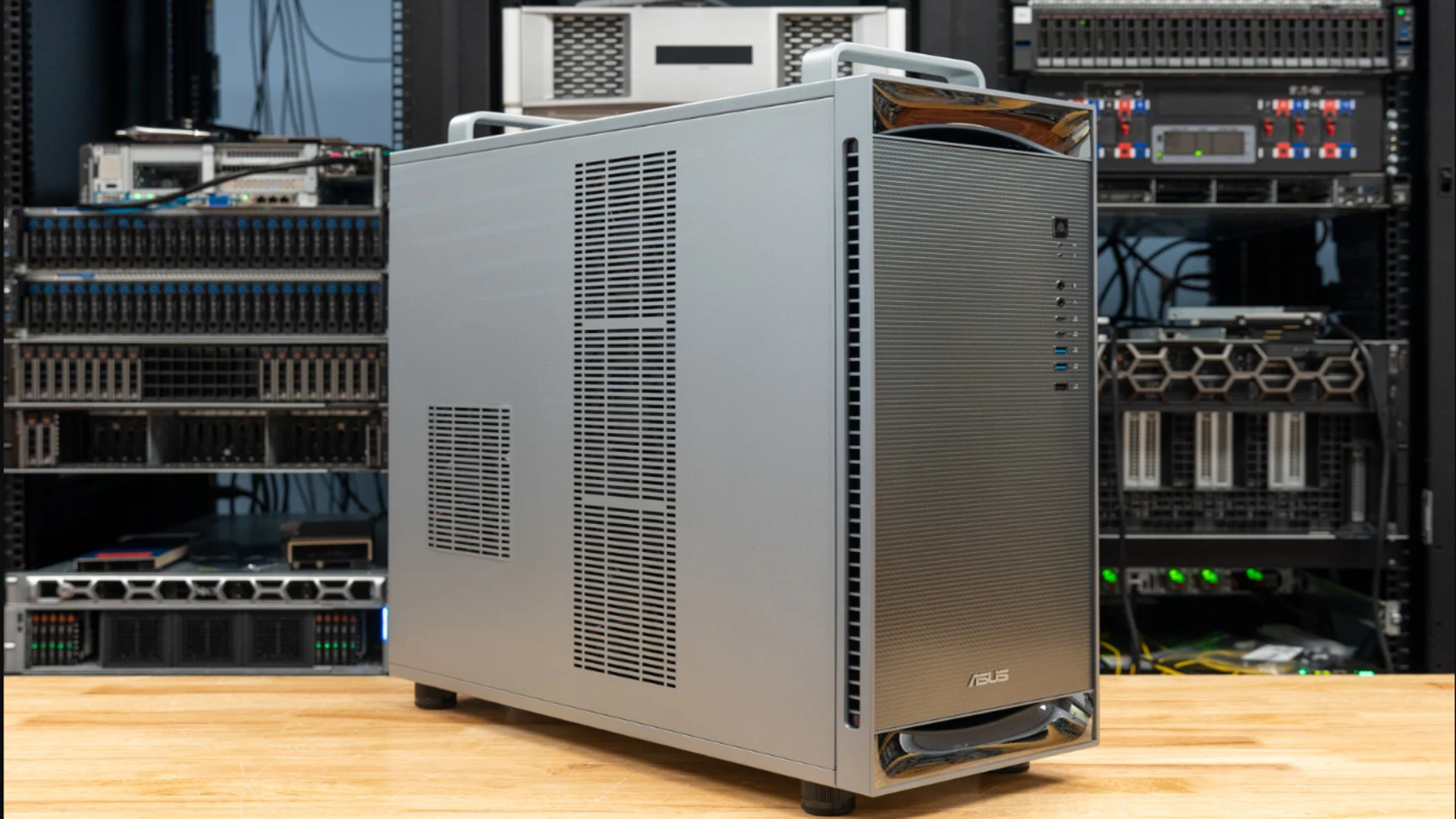
<![CDATA[ <article> <ul><li><strong>ASUS ExpertCenter Pro ET900N G3 weighs 27 kilograms net, built strictly for a desk</strong></li><li><strong>It combines 72 ARM cores with a Blackwell Ultra GPU inside</strong></li><li><strong>Coherent memory totals 748GB, unifying GPU and system memory together</strong></li></ul><p>Asus has released the ExpertCenter Pro ET900N G3 <a href="https://www.techradar.com/best/best-workstations">workstation</a>, powered by Nvidia’s GB300 Grace Blackwell Ultra Superchip for elite compute performance.</p><p>The tower features a net weight of 27kg and dimensions of 584 x 232 x 565 mm, making it ideal for a fixed desktop setup — or permanently positioned beneath the desk if the space is well-ventilated.</p><p>Portability was never part of the design goal here, since the machine combines 72 Arm cores, a Blackwell Ultra <a href="https://www.techradar.com/news/computing-components/graphics-cards/best-graphics-cards-1291458">GPU</a>, and 748GB of coherent memory into one chassis.</p><h2 id="a-workstation-built-with-a-look-and-cooling-system-of-its-own">A workstation built with a look and cooling system of its own</h2><p>The workstation features a distinct industrial design, sporting a brushed silver exterior, a dark mesh front panel, and two prominent metal handles fixed to the top edge.</p><p>These heavy-duty handles allow multiple staff members to safely relocate the unit without gripping the side panels directly.</p><p>Beneath the hood, Asus deploys an enterprise-grade, sealed liquid cooling loop equipped with copper cold plates to chill the Superchip, its adjacent memory modules, and the high-speed network card.</p><p>Because a liquid loop alone cannot reach every hot spot, a dedicated internal fan directs airflow straight onto the network card's optical transceivers to prevent thermal throttling under sustained networking loads.</p><p>Delivering power to this hardware is a massive 1,600-watt power supply certified at 80 PLUS Titanium efficiency, which drastically minimizes wall-power waste during peak computational compute cycles.</p><p>Out of the box, the system relies on a mirrored array of two 2TB NVMe drives to protect the operating system and software stack from single-drive failures.</p><p>For future scaling, the internal layout leaves room for three PCIe slots and two additional expansion bays to accommodate extra storage or supplemental graphics cards down the line.</p><p>During hardware testing, this architecture demonstrated remarkable data throughput on large-scale AI workloads, hitting 4,793 output tokens per second across 128 concurrent streams during the MiniMax M2.7 benchmark.</p><p>Massive models like GLM-5.2 pushed 215GB of expert weight data directly through the coherent memory fabric, bypassing the severe latency bottlenecks typically seen on standard system architectures.</p><h2 id="data-center-performance-on-a-desktop">Data center performance on a desktop</h2><p>Initial evaluations from hardware reviewers draw strong visual comparisons between this tower and Apple’s classic, boxy Mac Pro <a href="https://www.techradar.com/news/computing/pc/10-of-the-best-desktop-pcs-of-2015-1304391">computer</a> chassis.</p><p>Yet, the actual performance metrics place this workstation in a completely different class than any standard high-end desktop computer.</p><p>"The GB300 DGX Station remains the most capable thing we've ever put on a desk," said Brian Beeler, reviewer at <a href="https://www.storagereview.com/review/asus-expertcenter-pro-et900n-g3-review?type=Review" target="_blank" rel="nofollow">StorageReview</a>.</p><p>Running dozens of coding agents simultaneously, the machine sustained thousands of tokens per second without individual agents slowing down noticeably during testing.</p><p>The device ships with two 400-gigabit networking ports, supporting up to 800Gb/s combined bandwidth for linking directly with one additional GB300 station.</p><p>Together, two linked stations form a single 1,496GB coherent memory pool, doubling the standalone unit's capacity for handling larger models.</p><p>"Everything you're about to see, dozens of AIs all thinking at once, is running on this one machine, not a data center," said Alex Ziskind, technology YouTuber.</p><p>On GPT-OSS-120B, output climbed to 9,280 tokens per second, with total throughput reaching over 45,000 tokens per second.</p><p>Concurrency tests showed the system scaling smoothly from a single agent up to 128 running simultaneously without any noticeable system crash or slowdown.</p><p>Ziskind demonstrated this directly on video, watching power draw climb toward 1,000 watts while dozens of coding, research, and writing agents ran simultaneously.</p><p>ASUS has not publicly disclosed exact pricing for this device, though estimates so far peg this device to cost between $100,000 and $120,000.</p><figure class="van-image-figure inline-layout" data-bordeaux-image-check ><div class='image-full-width-wrapper'><div class='image-widthsetter' style="max-width:676px;"><p class="vanilla-image-block" style="padding-top:31.51%;"><img id="diM9tpwF2Lz85R8q85CT78" name="tr-g_news" alt="Google logo on a black background next to text reading 'Click to follow TechRadar'" src="https://cdn.mos.cms.futurecdn.net/diM9tpwF2Lz85R8q85CT78-1920-80.jpg" mos="" align="middle" fullscreen="" width="676" height="213" attribution="" endorsement="" class="inline"></p></div></div></figure> </article> ]]>