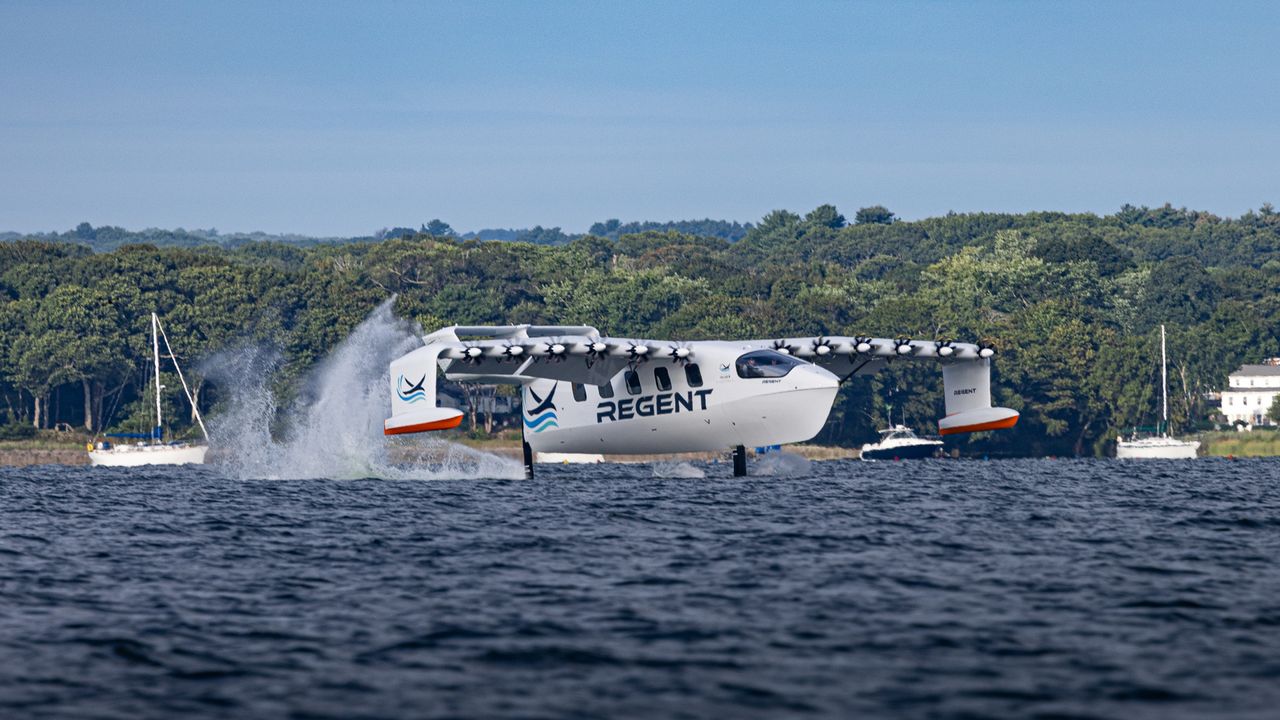
An electric plane that transforms into a boat just flew its first human-crewed flight — Viceroy Seaglider has a 15,000lbs MTOW and will fly up to 180 miles
REGENT Viceroy Seaglider has completed its first human-crewed flight above Narragansett Bay The electric craft flew 1,956 feet during its first crewed test Viceroy can shift between floating, hydrofoiling, and low-altitude flight modes REGENT Craft has completed the first crewed flight of its Vicero
<![CDATA[ <article> <ul><li><strong>REGENT Viceroy Seaglider has completed its first human-crewed flight above Narragansett Bay</strong></li><li><strong>The electric craft flew 1,956 feet during its first crewed test</strong></li><li><strong>Viceroy can shift between floating, hydrofoiling, and low-altitude flight modes</strong></li></ul><p>REGENT Craft has completed the first crewed flight of its Viceroy Seaglider, advancing development of an electric vessel designed for coastal transport.</p><p>The prototype carried two captains during a 30-second test above Narragansett Bay, reaching 33 ft while travelling 1,956 ft.</p><p>REGENT <a href="https://bynder.regentcraft.com/share/678DB458-BCB4-4991-AEC7AF1A02583E72/?viewType=grid" target="_blank" rel="nofollow">says</a> the flight marks the largest human-carrying all-electric wing-in-ground-effect craft to complete such a test.</p><h2 id="first-crewed-flight-tests-an-unusual-transport-concept">First crewed flight tests an unusual transport concept</h2><p>Viceroy combines a boat-like hull, underwater foils, and wings, allowing it to shift between water travel and low-altitude flight.</p><p>At low speeds, the craft remains afloat before hydrofoils lift its hull and prepare it for flight above the surface.</p><p>During test flight, the vehicle remains close to the water, operating within one wingspan of the surface rather than climbing conventionally.</p><p>"Completing this flight test validates years of rigorous engineering and operational work and gives us the confidence to move into full-rate production,” said Mike Klinker, co-founder and CTO at REGENT.</p><p>“We showed today that flying a Seaglider is every bit as smooth and safe as we designed it to be.”</p><p>REGENT says the production model will carry 12 passengers and two crew, with a maximum takeoff weight of 15,000 lbs.</p><p>Its planned flight speed reaches 180 mph, while its stated range extends to 180 miles between coastal destinations.</p><p>The company says passengers will have large windows, substantial legroom, and lower cabin noise than conventional aircraft during travel.</p><p>The craft uses a three-layer digital control system intended to manage stability while allowing mariners to operate it like watercraft.</p><p>REGENT says certified mariners will captain the vessels, while United States Coast Guard rules will govern operations within American waters.</p><h2 id="commercial-plans-expand-alongside-defence-work">Commercial plans expand alongside defence work</h2><p>These vessels are designed for coastal routes, where existing ports could support operations without conventional airport infrastructure.</p><p>About 40% of the global population lives in coastal communities, providing a large potential market for such services.</p><p>At the moment, the company has booked orders spanning six continents, while manufacturing capacity has been reserved across several future production years.</p><p>Earlier this year, REGENT announced an agreement involving The Twenty Five, which ordered as many as 60 Viceroy vessels.</p><p>The arrangement would make the operator REGENT's first United States delivery and launch partner for commercial Seaglider services.</p><p>Military versions for logistics, medical evacuation, surveillance missions, and other maritime applications requiring rapid movement are in development</p><p>The company holds a $15 million agreement with the United States Marine Corps Warfighting Laboratory for related development work.</p><p>REGENT completed construction of a 255,000-square-foot manufacturing facility in Rhode Island during June, with production activities beginning this year.</p><p>The facility is intended for structural assembly, wing and foil fitting, battery installation, systems work, and water-based testing.</p><p>“This is the moment we have been envisioning and tirelessly pursuing for the past five and a half years: REGENT has successfully proven safe, efficient ground-effect flight,” said Billy Thalheimer, co-founder and CEO at REGENT. </p><figure class="van-image-figure inline-layout" data-bordeaux-image-check ><div class='image-full-width-wrapper'><div class='image-widthsetter' style="max-width:676px;"><p class="vanilla-image-block" style="padding-top:31.51%;"><img id="diM9tpwF2Lz85R8q85CT78" name="tr-g_news" alt="Google logo on a black background next to text reading 'Click to follow TechRadar'" src="https://cdn.mos.cms.futurecdn.net/diM9tpwF2Lz85R8q85CT78.jpg" mos="" align="middle" fullscreen="" width="676" height="213" attribution="" endorsement="" class="inline"></p></div></div></figure> </article> ]]>
Read the full article on TechRadar
Read Full Article →