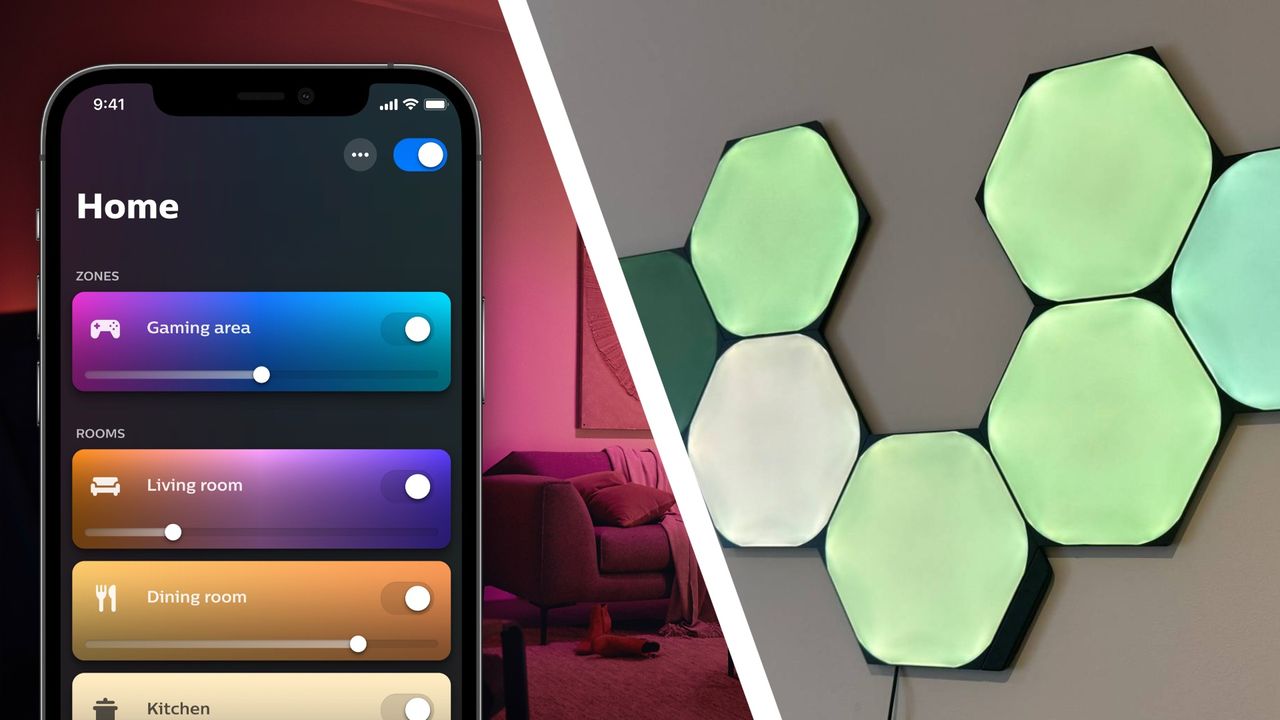
It's (almost) official: you'll soon be able to add your Nanoleaf lights to a Philips Hue system, as a support page briefly appears online
There's more evidence of a tie-in with Philips Hue and Nanoleaf An official support page appeared and then disappeared We could get an announcement about this later in the week A few days ago we heard some whispers that Philips Hue would be adding support for Nanoleaf Shapes, meaning these lights co
<![CDATA[ <article> <ul><li><strong>There's more evidence of a tie-in with Philips Hue and Nanoleaf</strong></li><li><strong>An official support page appeared and then disappeared</strong></li><li><strong>We could get an announcement about this later in the week</strong></li></ul><p>A few days ago we <a href="https://www.techradar.com/home/smart-lights/philips-hue-and-nanoleaf-could-soon-reveal-an-unlikely-tie-in-leaked-adapter-promises-to-bring-nanoleaf-led-modules-to-your-hue-app">heard some whispers</a> that Philips Hue would be adding support for Nanoleaf Shapes, meaning these lights could be controlled in the app — and now the integration has almost been officially confirmed.</p><p>As spotted by <a href="https://www.androidauthority.com/philips-hue-nanoleaf-integration-support-page-3704404/" target="_blank">Android Authority</a>, a support page for the Nanoleaf integration briefly went up on the Philips Hue website, explaining the types of light that would be supported, and explaining a little bit about how the tie-in will work.</p><p>That support page has now promptly disappeared again, suggesting that it was put up too early by mistake. According to the initial rumor, Philips Hue will be adding support for Nanoleaf integration on Thursday, September 3, which seems about right.</p><p>Put together that first leak and the brief appearance of an official support page, and it's now looking extremely likely that this will happen. However, until Philips Hue makes the announcement, nothing is guaranteed.</p><h2 id="nanoleaf-panels-behaving-like-hue-lights">Nanoleaf panels behaving like Hue lights</h2><figure class="van-image-figure inline-layout" data-bordeaux-image-check ><div class='image-full-width-wrapper'><div class='image-widthsetter' style="max-width:1920px;"><p class="vanilla-image-block" style="padding-top:56.25%;"><img id="NUsMEie24uN7zsRWeCK7x" name="Nanoleaf-Shapes.jpg" alt="Hexagonal-shaped LED light hang above a bed" src="https://cdn.mos.cms.futurecdn.net/NUsMEie24uN7zsRWeCK7x.jpg" mos="" align="middle" fullscreen="" width="1920" height="1080" attribution="" endorsement="" class="inline"></p></div></div><figcaption itemprop="caption description" class=" inline-layout"><span class="caption-text">A new Philips Hue wall module is expected to control Nanoleaf Shapes </span><span class="credit" itemprop="copyrightHolder">(Image credit: Nanoleaf)</span></figcaption></figure><p>According to the support page that has now been yanked from the web, the integration means Nanoleaf panels will "behave like a Hue light, ready to be used across your entire smart lighting setup".</p><p>There was also a line saying that Nanoleaf panels behave similarly to a gradient striplight", so you should be able to use the standard color wheel in the Philips Hue app to adjust the colors of the Nanoleaf panels you've got connected.</p><p>All of this will be made possible through a Philips Hue Wall Light Module that will connect to Nanoleaf devices. The support document lists Nanoleaf Hexagons, Triangles, and Mini Triangles as the smart lights that are going to be supported.</p><p>While there are still some questions about exactly how the connectivity is going to work — with a lot of smart home standards to account for — this seems like good news for both Philips Hue and Nanoleaf users.</p> </article> ]]>
Read the full article on TechRadar
Read Full Article →