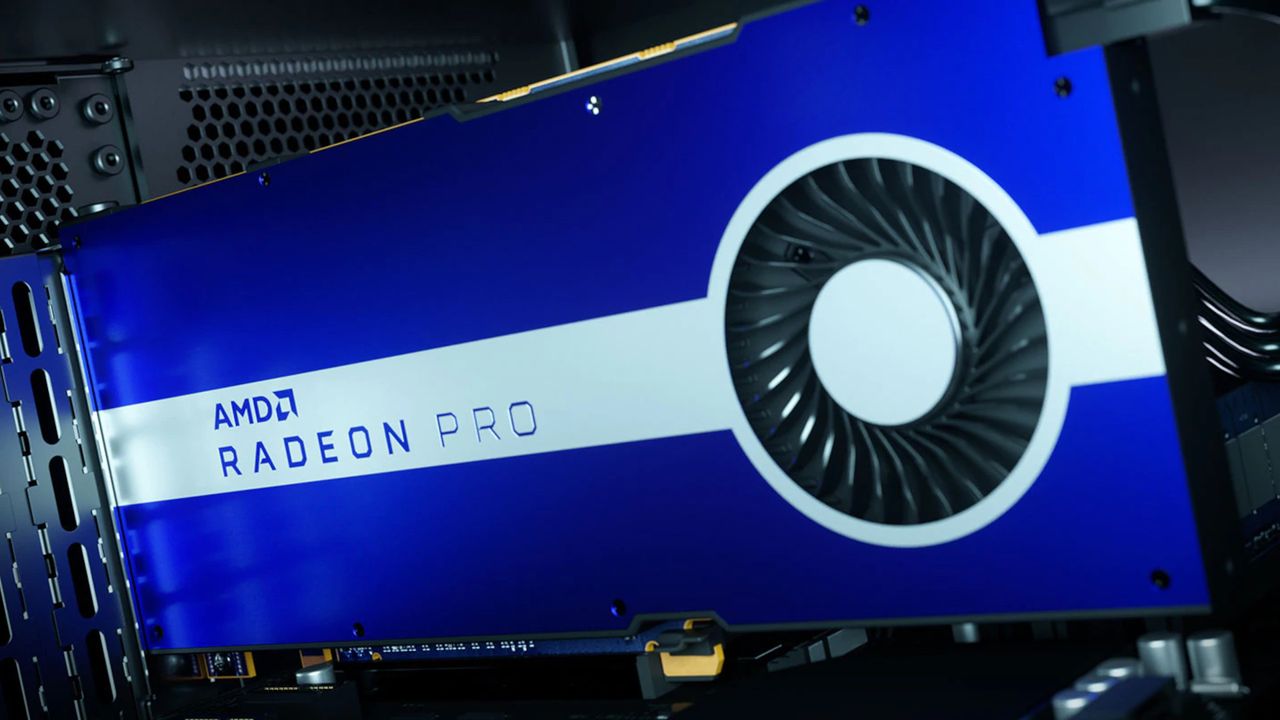
'That is where the machine starts winning on cost': Expert pits AMD Radeon AI PRO R9700 rig against ChatGPT and gives surprising verdict
Two AMD cards cost $18,775 yet beat GPT-5.6 Sol within hours weekly Multi-Token Prediction nearly doubled throughput to 320.2 tokens every second Twenty million monthly tokens save a team $11,738 yearly against Sol pricing A hardware reviewer compared a dual-GPU AMD workstation against cloud subscri
<![CDATA[ <article> <ul><li><strong>Two AMD cards cost $18,775 yet beat GPT-5.6 Sol within hours weekly</strong></li><li><strong>Multi-Token Prediction nearly doubled throughput to 320.2 tokens every second</strong></li><li><strong>Twenty million monthly tokens save a team $11,738 yearly against Sol pricing</strong></li></ul><p>A hardware reviewer compared a dual-GPU AMD workstation against cloud subscription pricing to determine which option delivers cheaper AI inference over time.</p><p>Two AMD Radeon AI PRO R9700 cards, each carrying 32 GB of memory, were installed inside a workstation costing roughly $18,775 as tested.</p><p>The evaluation measured electricity draw, token throughput, and amortized hardware cost, then set those figures against several cloud subscription tiers for comparison.</p><h2 id="how-cloud-pricing-sets-the-bar">How cloud pricing sets the bar</h2><p>Cloud AI providers charge customers per million tokens generated, with prices ranging from $1.20 for GPT-5.6 Luna up to $30 for GPT-5.6 Sol.</p><p>Mid-tier models sit in between, with Claude Sonnet 5 at $10 and Claude Opus 5 at $25 per million output tokens generated.</p><p>The more expensive the cloud model a team would otherwise use, the sooner owned hardware pays for itself.</p><p>Testing both AMD cards together, the <a href="https://www.techradar.com/best/best-workstations">workstation</a> generated 156.2 tokens every second while serving eight simultaneous users during this test.</p><p>A speed technique called Multi-Token Prediction nearly doubled that figure, pushing throughput up to 320.2 tokens every second, with identical output quality.</p><p>At that 320.2 token-per-second speed, the machine only needs 3.5 hours of weekly use to beat GPT-5.6 Sol on cost, 4.2 hours to beat Claude Opus 5, and 8.8 hours to beat Gemini 3.1 Pro.</p><p>A team generating above 20 million tokens per month against GPT-5.6 Sol pricing gains real savings using this owned hardware setup.</p><p>At that volume, running the workstation costs about $6,262 yearly in electricity and amortized hardware, against roughly $18,000 yearly in matching Sol fees.</p><p>That $11,738 yearly gap is the actual evidence behind the claim that heavy monthly usage makes AMD's rig worthwhile.</p><p>If a company instead relies on GPT-5.6 Luna, priced at just $1.20 per million tokens, that math flips entirely in the other direction.</p><p>The workstation would then need 94.3 hours of weekly use just to match that far cheaper cloud subscription's total cost.</p><p>Since a single week only contains 168 hours total, reaching that particular break-even point remains genuinely difficult without near constant, saturated usage.</p><p>Electricity itself was a minor factor throughout, since both cards together drew between 310 and 510 watts under sustained load conditions.</p><h2 id="where-the-economics-tip-in-amd-39-s-favor">Where the economics tip in AMD's favor</h2><p>A smaller team producing only five million tokens monthly, priced against Gemini 3.1 Pro, would spend $6,262 yearly to displace just $720 in cloud costs, a clear loss.</p><p>That comparison shows the hardware only makes financial sense once usage climbs high enough to close a large yearly cost gap.</p><p>A single R9700 card handled an eight billion parameter AI model alone, processing 34.5 tokens every second without help from a second card.</p><p>Running just one card also lowers the effective break-even point further, since a lone card draws far less power under equivalent load.</p><p>That single card pulled between 221 and 283 watts depending on simultaneous user count, well under the 310 to 510 watts both cards drew together.</p><p>Smaller models therefore offer a second path into positive economics, letting lighter workloads justify a $1,880 single-card purchase long before a team can justify the full $3,760 dual-card upgrade.</p><p>Price alone still does not settle the question, since these locally run models measurably trail top cloud systems on complex reasoning benchmarks.</p><p>On one independent intelligence index, the 27 billion parameter AMD model scored 37 points against Google's Gemini 3.1 Pro scoring 46 points instead.</p><p>Therefore, a team chasing the cheaper token count may be trading away real reasoning quality, not just cloud subscription fees.</p><p>Via <a href="https://www.pugetsystems.com/labs/articles/amd-radeon-ai-pro-r9700-dual-gpu-ai-inference-performance/" target="_blank" rel="nofollow">Puget Systems</a></p><figure class="van-image-figure inline-layout" data-bordeaux-image-check ><div class='image-full-width-wrapper'><div class='image-widthsetter' style="max-width:676px;"><p class="vanilla-image-block" style="padding-top:31.51%;"><img id="diM9tpwF2Lz85R8q85CT78" name="tr-g_news" alt="Google logo on a black background next to text reading 'Click to follow TechRadar'" src="https://cdn.mos.cms.futurecdn.net/diM9tpwF2Lz85R8q85CT78.jpg" mos="" align="middle" fullscreen="" width="676" height="213" attribution="" endorsement="" class="inline"></p></div></div></figure> </article> ]]>
Read the full article on TechRadar
Read Full Article →