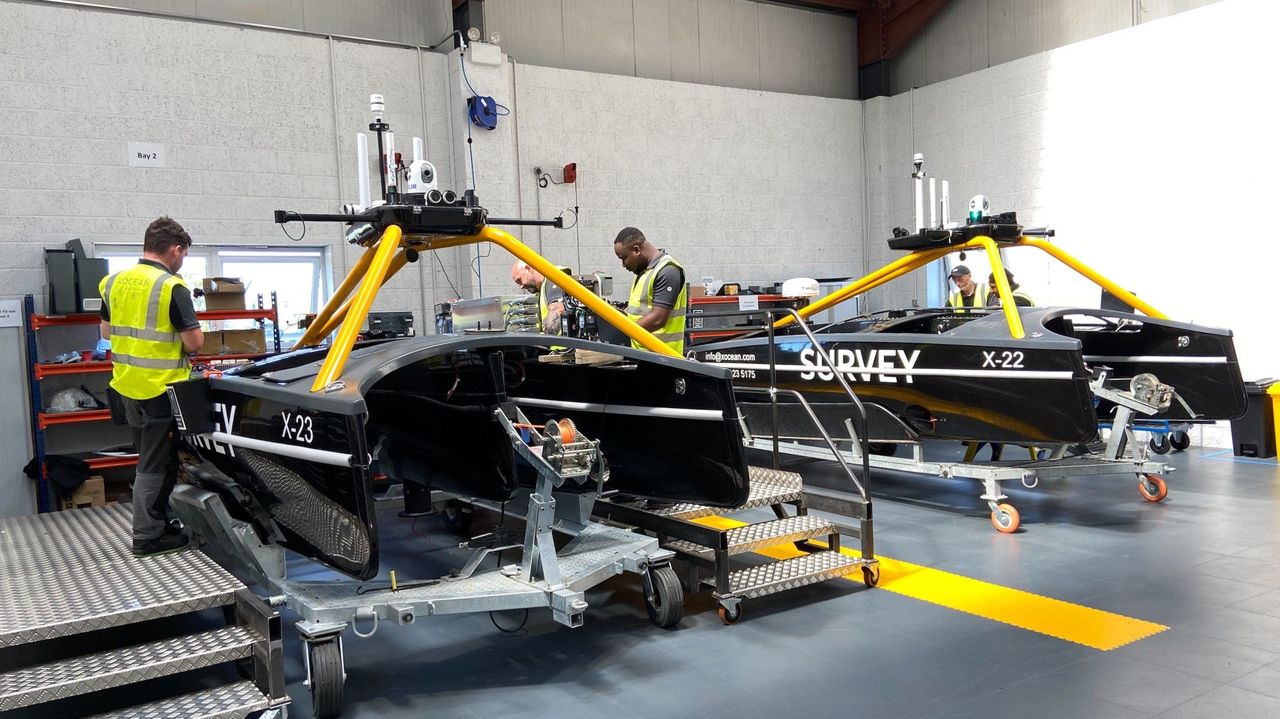
'We operate fleets of smaller, lower-cost assets that are centrally controlled and highly scalable': How tiny uncrewed vessels are mapping the ocean and delivering instant marine data at scale
While many tech companies are looking to planetary bodies and the stars as the next frontier of exploration, there is one much closer to the shiny blue marble we call home that has been largely unexplored.
<![CDATA[ <article> <p>While many tech companies are looking to planetary bodies and the stars as the next frontier of exploration, there is one much closer to the shiny blue marble we call home that has been largely unexplored.</p><p>According to a 2025 study by Science Advances, humanity has visually explored just 0.001% of the ocean, and much of this has been relatively close to shorelines. But while our visual exploration of the ocean sits as a minute proportion its overall size, militaries and private industries have developed innovative ways to gather ocean data. Sonar, echosounding, and magnetometery all play their parts.</p><p>Our capacity to use the ocean as a global asset is also increasing. Think about the expansion of off-shore windfarms, delivering global connectivity through sub-sea cables, our understanding of the role the ocean plays in climate, and searching for new untapped resources at the bottom of the sea. Of course, there are a whole range of risks and challenges that space exploration doesn't have to contend with.</p><h2 id="usvs-are-changing-the-industry-but-require-better-cloud-communications">USVs are changing the industry, but require better cloud communications</h2><p>Planning and delivering off-shore projects is a hugely expensive endeavor. The sea floor needs to mapped for its geology and structural stability, and companies require oceanography data to understand tides and sea conditions. Traditionally, the collection of this data uses large, highly specialised vessels equipped with a crew who can not only navigate the ocean, but also study it. Putting these expenses at sea also brings enormous risk.</p><p>Luckily, the rapid advancement of drone technology and uncrewed vessels alongside increases in the speed and capacity of data transfer means this industry is rapidly adapting.</p><p>XOCEAN is an ocean data delivery company that has specialised in deploying Uncrewed Surface Vessels (USVs) to gather data for a range of industries across offshore energy, fishing, bathymetry, and more. These vessels are capable of quickly delivering the data they gather using cloud connectivity, allowing for near-real time access and processing.</p><p>I spoke to James Ives, CEO of XOCEAN, to understand how USVs can deliver the data they collect so quickly, the challenges the vessels face, and how the industry is likely to evolve in the future.</p><ul><li><strong>Can you offer us a glimpse of the technical challenges - and solutions you developed - tackled to maintain a consistent, high bandwidth data stream from the uncrewed surface vessels to the data centre?</strong></li></ul><p>XOCEAN operates in environments where connectivity is constrained and conditions are constantly changing, but the expectation from clients is continuous, high-quality data. We have addressed this by designing the system end-to-end. Data is streamed in near real time from offshore into a cloud-based processing environment, with intelligent control over what is prioritised, processed, and scaled in the cloud.</p><p>We don’t focus on moving more data, but on delivering usable data faster, removing delays from the process and improving how clients experience offshore data delivery.</p><ul><li><strong>I cannot not think about space and Ukraine when I look at what XOCEAN is doing. Like them, you are embracing the concept of small is beautiful. Nimble, numerous, almost dispensable, affordable. What lessons have you learnt from other industries in developing XOCEAN's business?</strong></li></ul><p>XOCEAN has learned that scale comes from systems, not size. Instead of relying on a small number of large, expensive vessels, we operate fleets of smaller, lower-cost assets that are centrally controlled and highly scalable.</p><p>That scalability is enabled not just offshore, but through the way we manage and process data in the cloud, using AWS infrastructure to support a distributed, resilient operating model.</p><p>This reduces single points of failure, increases flexibility, and allows us to adapt quickly to changing conditions whether that’s weather, permitting or evolving scope.</p><p>Ultimately, we have built a better delivery model, one that is more efficient, more flexible and lower risk.</p><ul><li><strong>One stat you mentioned in the press release was that XOCEAN has 30x more women in maritime roles than the International Maritime Organization average. What impact - if any - does it have on the way XOCEAN runs?</strong></li></ul><p>XOCEAN’s operating model removes the need for people to be offshore, which opens up maritime roles to a much broader and diverse talent pool. That has a direct impact on how we run. More balanced teams across operations, engineering and data lead to better decision-making and stronger collaboration.</p><ul><li><strong>You mention that XOCEAN expects its operations to support the development of more than 100 GW of offshore wind capacity. Can you tell me a bit more about where that data comes from?</strong></li></ul><p>XOCEAN tracks the offshore wind projects it supports globally, based on the installed or planned capacity of those developments. To date, our work has contributed to projects representing approximately 48 gigawatts of offshore wind capacity. That figure comes directly from the projects we’ve delivered data on, across development, construction and operations. The 100 gigawatt figure is a forward-looking view, based on our current project pipeline and the programmes we’re actively supporting with clients.</p><ul><li><strong>What does the future looks like for XOCEAN and its competitors? Will the boats evolve to become autonomous amphibians? Will a lot of the AI and processing happen at the edge? Will they be self-powered by waves?</strong></li></ul><p>There will be continuous innovation in the autonomy, power systems, edge processing, all of that will evolve but the real shift is moving from asset-led to system-led. The advantage won’t come from a single vessel or technology. It will come from how you integrate acquisition, remote operations and processing into a single, scalable platform, underpinned by cloud infrastructure like AWS.</p><ul><li><strong>If you could ask your infrastructure provider (AWS) to design one tool that would make the work carried out by XOCEAN far more efficient, what would it be?</strong></li></ul><p>XOCEAN would benefit from a fully integrated, real-time operating layer for offshore data.</p><p>We already connect data acquisition, remote operations and processing into a single platform, using AWS infrastructure, but there’s an opportunity to go further where data can directly trigger operational decisions across the system. That kind of closed-loop system would significantly increase efficiency and unlock the next level of scale.</p> </article> ]]>
Read the full article on TechRadar
Read Full Article →